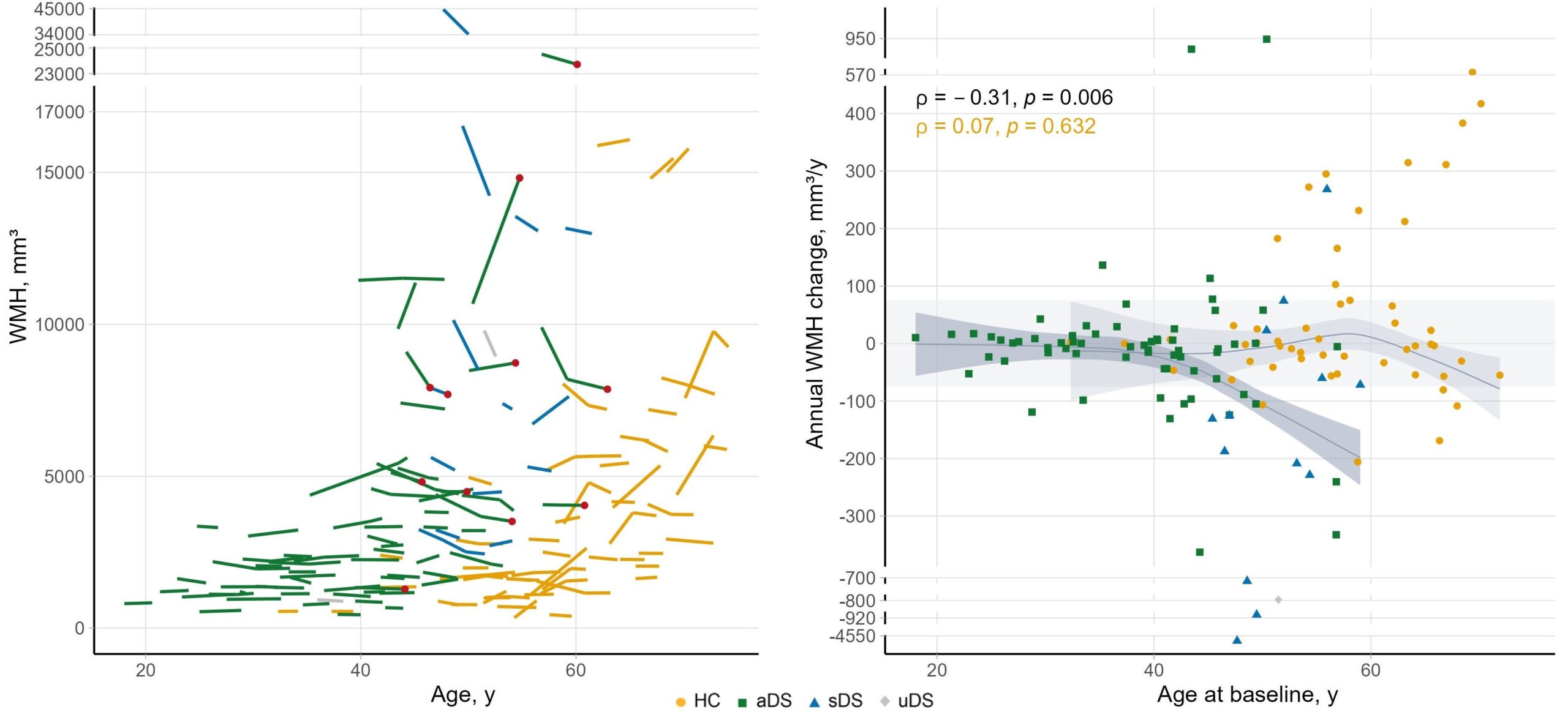
Temporal dynamics of white matter hyperintensities related to Alzheimer’s disease in adults with Down syndrome

Temporal dynamics white hyperintensities Down Syndrome - Sant Pau Memory Unit - Alzheimer - Barcelona

White matter hyperintensities (WMH) White matter hyperintensities (WMH) are brain lesions visible on MRI that have traditionally been linked to vascular disease. In a previous study from our group, we showed that WMH burden increases approximately 10 years before the onset of Alzheimer’s disease (AD) symptoms in people with Down syndrome (DS) and continues to … Read more

Sofia Segura Pellicer

Sofia Segura Pellicer

  Sofia Segura Pellicer holds a degree in Physics from the University of Barcelona and a Master’s in Biomedical Engineering from the International University of Valencia. In 2025, she completed a master’s internship at the Hospital de la Santa Creu i Sant Pau in the field of neuroimaging, which involved a research project to implement … Read more

Zhao Zili

Zhao Zili

Zhao Zili graduated in 2014 with a degree in Clinical Medicine. After graduation, she worked in clinical practice for six years, focusing on internal medicine. She completed a three-year standardized residency training program at Henan Provincial People’s Hospital and obtained the qualification of Attending Physician in Internal Medicine. In 2020, she pursued a Master’s degree … Read more

Maria Franquesa Mullerat

Maria Franquesa Mullerat

Maria Franquesa Mullerat holds a degree in Biotechnology from the University of Barcelona. In 2023, she joined the Memory Unit as a master’s student, where she conducted a study on cerebral perfusion in individuals with Down Syndrome across the Alzheimer’s disease continuum, under the supervision of Dr. Alexandre Bejanin. In 2024, she began her PhD, … Read more

Brain Metabolism in Alzheimer’s Disease Associated with Down Syndrome: New Findings with FDG-PET

Regional Brain Metabolism across the Alzheimer's Disease Continuum in Down Syndrome

Down syndrome (DS) is a genetic form of Alzheimer’s disease (AD). Due to the overexpression of the APP gene on chromosome 21, nearly all individuals with DS develop AD-related pathological changes and dementia secondary to this disease. Brain metabolism, measured using fluorodeoxyglucose positron emission tomography ([¹⁸F]FDG-PET), is considered a biomarker of AD-related neurodegeneration. This recent … Read more

Medial Temporal Lobe Atrophy in Down Syndrome Along the Alzheimer’s Disease Continuum

Medial Temporal Lobe Atrophy in Down Syndrome Along the Alzheimer’s Disease Continuum The medial temporal lobe (MTL) is one of the first regions affected by tau pathology, making structural changes in these areas promising biomarkers for identifying early signs of Alzheimer’s disease (AD). However, little is known about the integrity of these regions in individuals … Read more