
The first step in the diagnostic workup of individuals presenting with cognitive symptoms is to determine whether there is objective cognitive impairment. Ideally, this is done through a neuropsychological evaluation: a battery of cognitive tests in which the patient’s performance is interpreted as normal or abnormal as compared to reference values. These reference values are derived from a sample of cognitively unimpaired individuals, traditionally accounting for age and educational level.
From a biological perspective, Alzheimer’s disease begins years before symptom onset. At this early stage (referred to as preclinical stage) there is already a mild, but significant, impact on cognitive performance. Therefore, if data used to calculate reference values for cognitive normality provide from individuals with biological evidence of Alzheimer’s disease, the results may be less precise.
¿What has been done in these studies?
Both studies are born from the collective effort of four centers: Hospital de la Santa Creu i Sant Pau (Barcelona), Hospital Clínic (Barcelona), Fundación CITA-Alzhéimer (San Sebastián), and Hospital Universitario Marqués de Valdecilla (Santander).
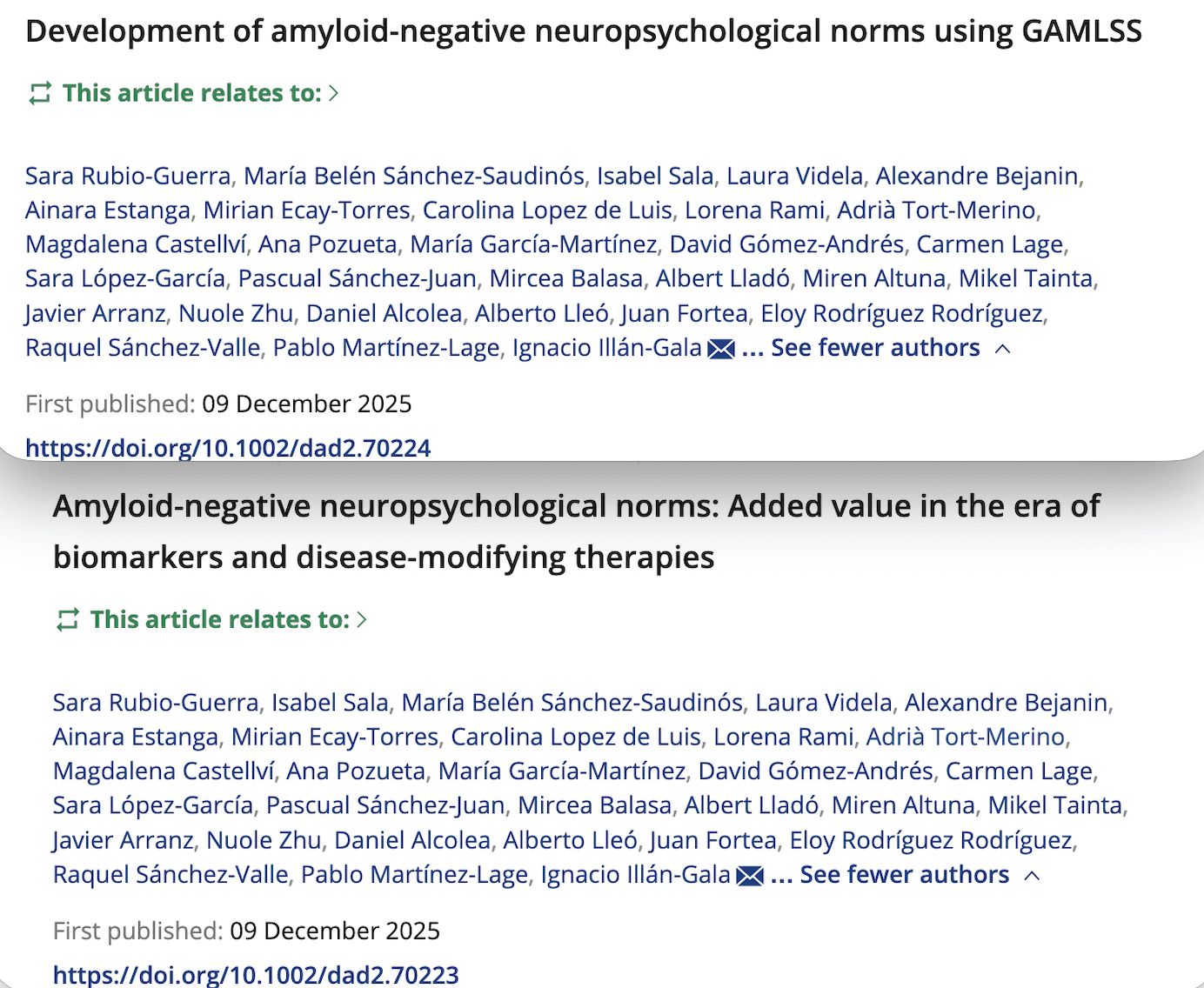
In the first study, data from 774 cognitively unimpaired individuals without biological evidence of Alzheimer’s disease have been used to derive new reference values of cognitive normality. To do so, we used advanced statistical models, and examined the effects of age, education, and sex.
In the second study, in a sample of 2405 individuals without dementia, we compared the accuracy of new reference values in detecting cognitive impairment with that of traditional reference values.
Main results
New reference values show that, in addition to age and educational level, biological sex has a significant effect on cognitive performance.
Compared to traditional norms, the diagnosis of cognitive impairment based on new reference values yields stronger associations with Alzheimer’s disease biomarker positivity and cognitive worsening during follow-up.
Putting it in numbers, new reference values would enable earlier detection of one out of every five cases of mild cognitive impairment, particularly Alzheimer’s disease-related cognitive impairment.
Relevance of the studies
Recently, the first disease-modifying therapies for Alzheimer’s disease have been approved. These therapies have proven to be more effective and safer when given in the early stages of cognitive impairment. In this context, accurate reference values for neuropsychological performance are crucial for early detection of cognitive impairment.