

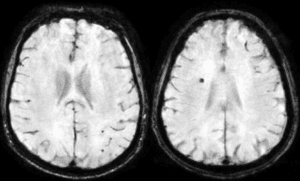
Anti-amyloid drugs have emerged as a promising treatment for Alzheimer’s disease. However, these treatments can potentially cause cerebral microbleeds – small brain bleeds that may occur when amyloid is cleared from blood vessels. Understanding the natural history of these microbleeds is crucial for safe patient treatment and monitoring.
This study, published in Neurology, provides key insights into the occurrence of cerebral microbleeds in Down syndrome, a population genetically predisposed to develop Alzheimer’s Disease.
What did we do in this study?
In this study, we segmented microbleeds in the brain scans of 276 individuals with Down syndrome, and 158 controls. We then examined the distribution of microbleeds in the brain, and looked at their associations with biomarkers (plasma, CSF, and MRI) and cognitive outcomes of Alzheimer’s disease.
Main results
We found that:
- Adults with Down syndrome were more likely to have microbleeds than controls (20% vs 8.9%)
- Microbleed prevalence increased with age and Alzheimer’s disease progression.
- The distribution was predominantly posterior and lobar, associated with the buildup of amyloid in the cerebral blood vessels.
- Microbleeds were most strongly associated with hippocampal volumes (an indication of brain atrophy) and CSF p-tau-181 (a key indicator of Alzheimer’s).
- Microbleeds did not have a significant impact on cognitive performance in Down syndrome.
Relevance of this study
These findings suggest an interplay between Alzheimer’s disease pathology and vascular lesions in Down syndrome, which can have implications for the use of anti-amyloid therapies in this population. This highlights the need for careful monitoring during treatment, and the development of tailored treatment approaches as they develop Alzheimer’s disease.