


We welcome our new team members!💙
Welcome to the Memory Unit! We continue growing and adding talent to our team. We welcome our new team members and the professionals joining our Memory Unit during this period of training and collaboration. Visiting health professionals Professional Centre /...
Chronic traumatic encephalopathy found in three Creutzfeldt–Jakob disease cases
Introduction: What do we know about head injuries and neurodegenerative diseases? Chronic traumatic encephalopathy (CTE) is a neurodegenerative disease associated with repetitive head impacts and has been linked particularly to long-term participation in contact...
Institutions
🏥 Hospital Sant Pau →
🔬 Institut de Recerca →
💚 AFAB →
🧑🏽⚕️ I have an appointment at the memory unit →
Educational sessions
We welcome our new team members!💙
Welcome to the Memory Unit! We continue growing and adding talent to our team. We welcome our new team members and the professionals joining our Memory Unit during this period of training and collaboration. New team members Marc Sans ↗ Visiting health...
Changes in serum β-synuclein precede blood biomarkers of Alzheimer pathology in Down syndrome
Synaptic dysfunction is one of the earliest processes involved in Alzheimer’s disease (AD) and is closely associated with cognitive decline. However, currently available blood biomarkers primarily reflect other pathological processes, such as amyloid and tau...
Digital cognitive assessment and blood biomarkers: two complementary perspectives for assessing Alzheimer’s disease
Digital cognitive assessment and blood biomarkers: two complementary perspectives for assessing Alzheimer’s disease Blood-based biomarkers are making it easier to detect biological changes associated with Alzheimer’s disease through a simple blood test. However, on...
Epilepsy increases following the onset of Alzheimer’s disease in adults with Down syndrome
A strong link between the onset of Alzheimer’s and epileptic seizures In adults with Down syndrome, the risk of developing Alzheimer’s disease is particularly high due to genetic factors. In this study, we focused on analyzing the natural history of...
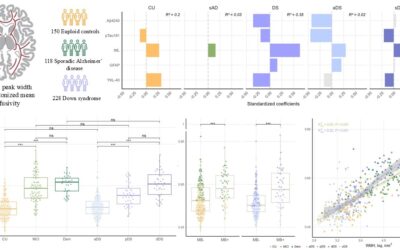
Peak width of skeletonized mean diffusivity reveals early and multifactorial white matter injury across sporadic and Down syndrome–associated Alzheimer’s disease
White matter alterations are commonly observed in Alzheimer’s disease (AD) and reflect a convergence of several pathological processes, including myelin loss, axonal degeneration, and microvascular injury. Peak width of skeletonized mean diffusivity (PSMD) is a...
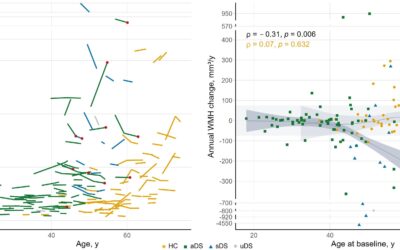
Temporal dynamics of white matter hyperintensities related to Alzheimer’s disease in adults with Down syndrome
White matter hyperintensities (WMH) White matter hyperintensities (WMH) are brain lesions visible on MRI that have traditionally been linked to vascular disease. In a previous study from our group, we showed that WMH burden increases approximately 10 years before the...