
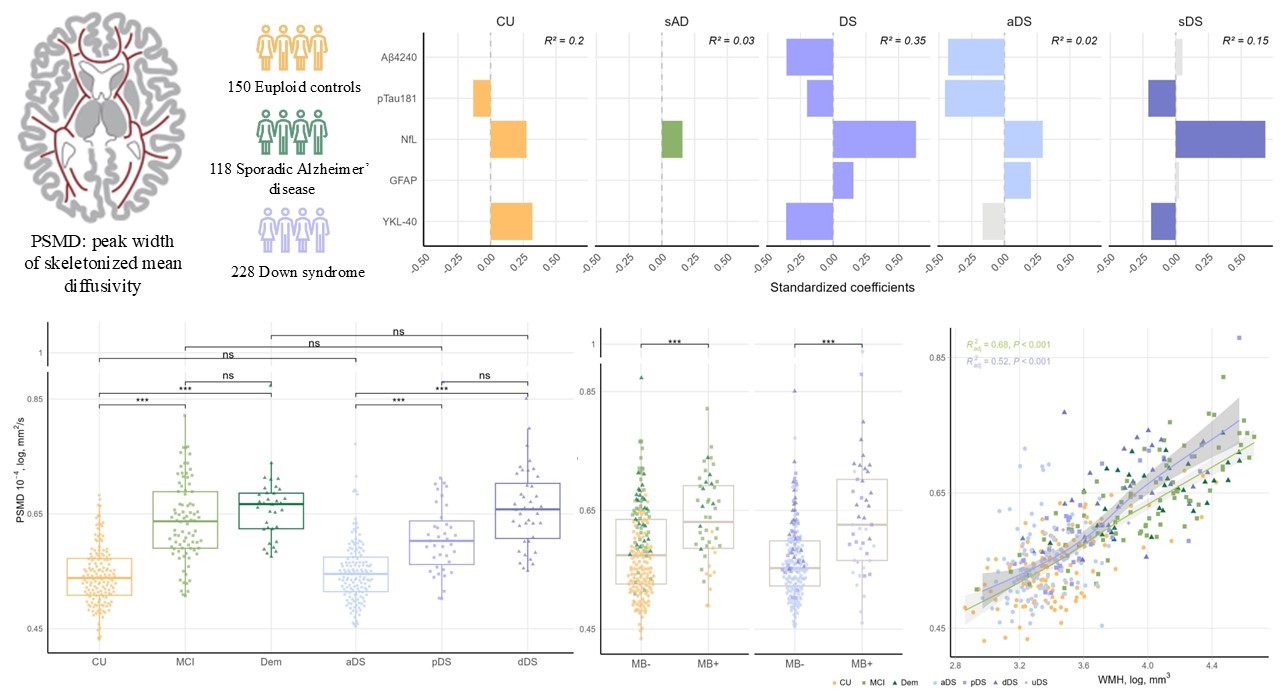
White matter alterations are commonly observed in Alzheimer’s disease (AD) and reflect a convergence of several pathological processes, including myelin loss, axonal degeneration, and microvascular injury. Peak width of skeletonized mean diffusivity (PSMD) is a diffusion MRI–derived metric of diffuse white matter injury that has demonstrated high sensitivity to microstructural damage. However, the timing of PSMD changes in AD and the biological mechanisms underlying these alterations remain insufficiently characterized, particularly in genetically defined populations.
This study, published in the Journal of Alzheimer’s and Dementia, provides new evidence that PSMD captures early and multifactorial white matter injury in both sporadic AD and Down syndrome (DS)-associated AD.
What was done in this study?
This cross-sectional study examined PSMD in a large cohort including adults with DS, individuals with sporadic AD, and euploid controls. PSMD was derived from 3T-MRI diffusion tensor imaging, and its associations with age, clinical stage, cerebrospinal fluid (CSF) biomarkers, and small vessel disease markers were investigated.
Key findings
-
PSMD showed age-related increases in all groups, with a significantly stronger association in DS, where alterations were detectable approximately 15 years before the expected age of dementia onset.
-
PSMD increased with advancing AD clinical severity in both sAD and DS, reflecting progressive white matter damage along the disease continuum.
-
Higher PSMD was associated with CSF neurofilament light chain (NfL), microbleeds and white matter hyperintensities (WMH supporting the multifactorial nature of white matter damage.
-
PSMD abnormalities were more frequent than visible WMH, especially in adults with DS, suggesting that PSMD may detect early microstructural white matter changes before they become visible on conventional MRI.
Why is this important?
These findings position PSMD as a sensitive early biomarker of white matter injury across both sporadic and Down syndrome–associated Alzheimer’s disease, capable of detecting alterations before symptom onset.
In the current era of anti-amyloid therapies, and with the increasing inclusion of people with Down syndrome in clinical trials, characterizing early white matter changes is essential to monitor disease progression, assess treatment efficacy and safety, and guide clinical care.