
Frontotemporal dementia (FTD) encompasses a diverse group of neurodegenerative diseases characterized by progressive deterioration in social behavior, language, and executive functions. This condition has a strong genetic basis, with up to 30% of affected individuals carrying autosomal dominant mutations. Sex has gained importance in neurodegenerative research, especially in Alzheimer’s disease, where evidence shows that, together with gender, it influences cognitive decline and biomarker progression. Studying families with autosomal dominant FTD provides a unique opportunity to observe how symptoms evolve and what changes occur in biomarkers from early to advanced stages.
What was done in this study?
A total of 394 individuals with genetic FTD and 279 controls from the international ALLFTD consortium were studied. Annual neuropsychological assessments were conducted, and cortical thickness was measured via MRI. Clinical features and cortical thickness were compared between men and women to estimate “cognitive reserve” (the ability to maintain cognitive performance despite neurodegeneration), and sex differences in the progression of these measures over time were analyzed.
Main findings
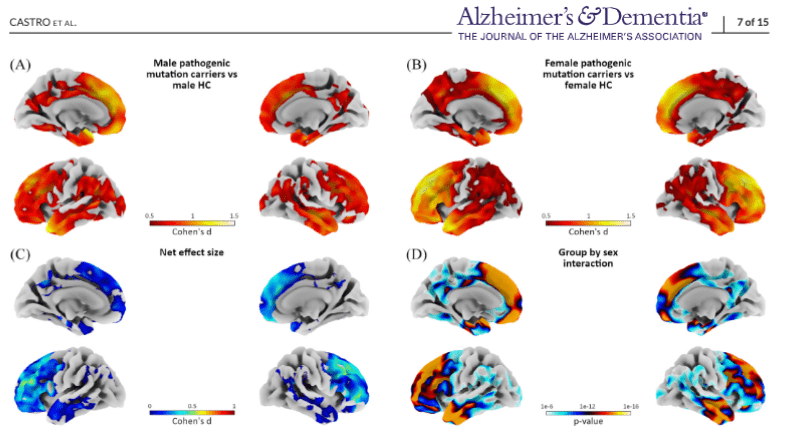
- Symptomatic women carrying a pathogenic FTD mutation had lower-than-expected frontal cortical thickness compared to men, relative to their performance in executive function and social cognition. These findings suggest greater cognitive and behavioral reserve in women.
- Differences were especially marked in the subgroup of carriers of the C9orf72 repeat expansion.
- Sex differences in cognitive reserve were more pronounced at symptom onset but diminished as the disease progressed.
Study relevance
Our findings suggest that women with genetic FTD have greater cognitive and behavioral reserve compared to men. Future studies on prognosis and treatment of FTD should include sex-stratified analyses to support precision medicine strategies.