

Blood biomarkers have become a key tool for diagnosing Alzheimer’s disease in a more accessible way. While plasma p-tau217 is already established as a strong diagnostic marker, little was known about its ability to predict how the disease progresses across different clinical stages. In this study, published in Neurology, we show that plasma p-tau217 is consistently associated with cognitive decline and increased risk of progression to dementia.
What has been done in this study?
 We analysed data from over 700 individuals with positive Alzheimer’s disease biomarkers in cerebrospinal fluid, enrolled in the SPIN cohort from the Memory Unit at Hospital Sant Pau. Participants were at different clinical stages, from preclinical to dementia, and were followed clinically for up to 10 years. Plasma p-tau217 levels were measured, and their association with cognitive decline and conversion to dementia was assessed.
Main results
- Plasma p-tau217 levels increase progressively with clinical worsening, from the earliest stages with no apparent symptoms to advanced dementia.
- This increase was more pronounced than tau in cerebrospinal fluid (p-tau181), suggesting that plasma p-tau217 may better reflect disease severity.
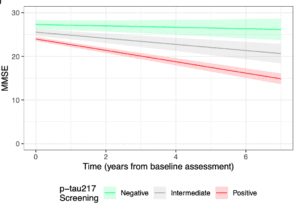
- Higher baseline p-tau217 levels were associated with faster cognitive decline and a greater likelihood of progressing to dementia.
- Even in individuals with very mild cognitive symptoms, high p-tau217 levels were linked to a progression risk like that of people with more evident cognitive impairment but lower biomarker levels. This indicates that p-tau217 may help better identify the true risk in each patient.
- As a blood-based marker, p-tau217 could become a key tool to complement clinical evaluation and guide more personalised monitoring and treatment decisions.
Relevance of the study
This study shows that plasma p-tau217 is more than just a diagnostic marker: it can also help predict clinical progression in Alzheimer’s disease. This can be essential for identifying individuals at higher risk of decline, tailoring clinical follow-up, and improving the selection of participants for disease-modifying trials. Moreover, as a non-invasive test, it’s beneficial in clinical settings where access to lumbar puncture or PET imaging is limited.