
Digital cognitive assessment and blood biomarkers: two complementary perspectives for assessing Alzheimer’s disease
Blood-based biomarkers are making it easier to detect biological changes associated with Alzheimer’s disease through a simple blood test. However, on their own, they do not tell us whether a person has cognitive impairment or how it affects their functioning.
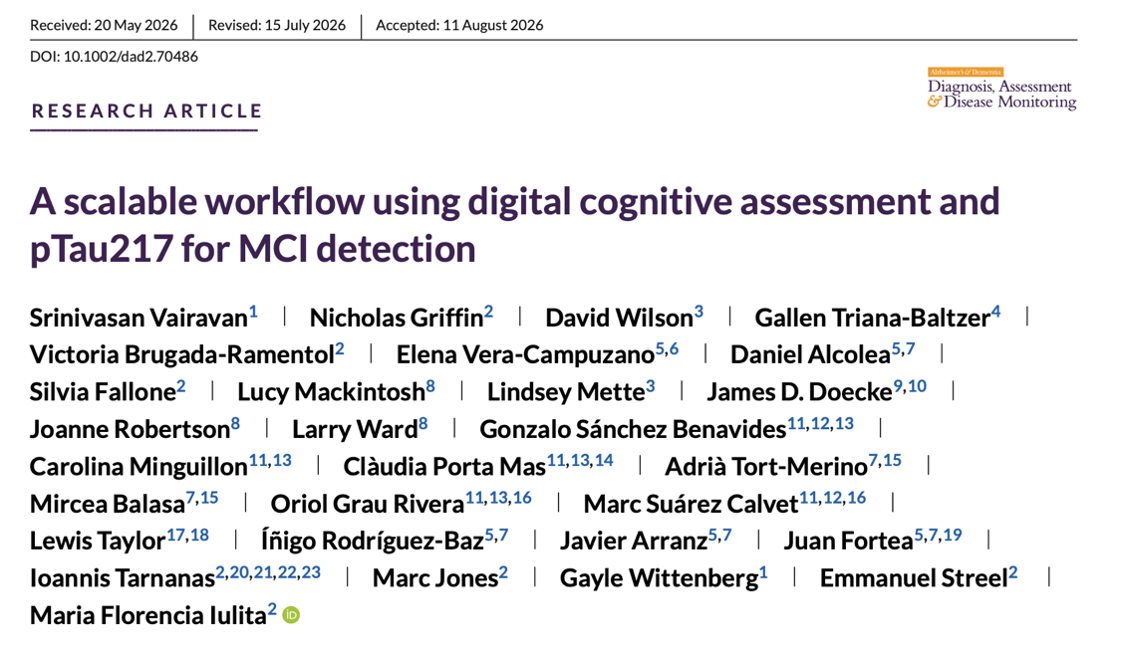
A new international study, published in Alzheimer’s & Dementia: Diagnosis, Assessment & Disease Monitoring and involving the Sant Pau Memory Unit, has examined how a digital cognitive assessment and a blood-based Alzheimer’s biomarker, p-tau217, can provide complementary information on these two dimensions of the disease.
What was done in this study?
The study included 688 participants from Australia, Barcelona, and the United States.
Participants completed an assessment using the Altoida NeuroMarker, a self-administered digital tool that collects information on different aspects of cognitive functioning through tasks performed on a tablet. In addition, plasma p-tau217 levels were measured in a subgroup of participants.
The researchers analysed the ability of the digital assessment to identify mild cognitive impairment (MCI), examined its relationship with p-tau217 levels, and modeled how both tools could potentially be used sequentially as part of a diagnostic process.
Main findings
The digital assessment was able to distinguish people with mild cognitive impairment (MCI) from those without cognitive impairment.
People identified as having MCI through the digital assessment were more likely to have elevated p-tau217 levels.
This demonstrates a relationship between digitally detected cognitive and functional changes and a biomarker of the biology of Alzheimer’s disease.
In a theoretical two-step model, using the digital cognitive assessment first made it possible to identify a population more likely to have Alzheimer’s pathology before performing the blood-based biomarker test.
Why is this relevant?
Cognitive assessment and blood-based biomarkers provide different and complementary information. Cognitive assessment helps characterize whether cognitive impairment is present and how it manifests, while p-tau217 provides information about the possible presence of Alzheimer’s pathology.
As blood-based biomarkers become increasingly incorporated into clinical practice, having objective and accessible ways of assessing cognition may help more people benefit from advances in the diagnosis and treatment of Alzheimer’s disease.
This study represents a first step towards exploring how both tools could be used together.
We would like to thank all the participants and their families, whose contribution made this work possible.